Against All Odds: A Rare High-Risk Pregnancy
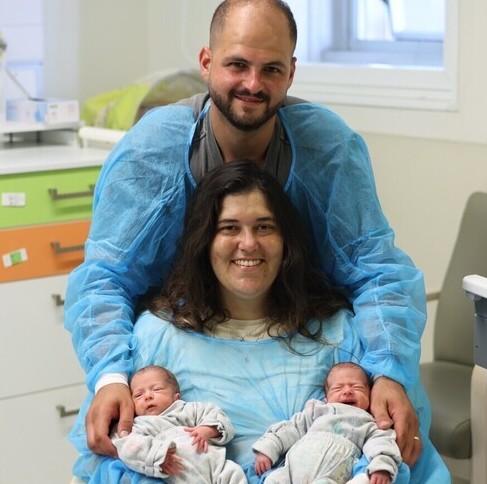
July 13, 2026 – Lior and Aviv Zucker faced an impossible decision—to terminate a rare, high-risk pregnancy or continue despite the significant danger to their unborn babies. Choosing hope, and guided by an expert multidisciplinary team at Rambam Health Care Campus (Rambam) in Haifa, Lior went on to deliver two healthy baby girls.
Lior Zucker (29), from Kiryat Haim near Haifa, has polycystic ovary syndrome (PCOS), a condition that can make it more difficult to conceive. The couple were overjoyed when they learned they were expecting their first child. However, following an ultrasound at seven weeks’ gestation, they received unexpected news: Lior was carrying twins.
The scan revealed an extremely rare monochorionic monoamniotic twin pregnancy, commonly called a “mono-mono” pregnancy, in which identical twins share both the placenta and a single amniotic sac without a separating membrane. This uncommon condition carries significant risks and is classified as a high-risk pregnancy.
Despite repeated recommendations to terminate the pregnancy, Lior never lost faith that everything would be okay. Although they faced considerable pressure, she and Avi chose to continue the pregnancy. As they came to understand the complexity of the diagnosis, they spent the first trimester searching for a specialist willing to support their decision. They eventually found Professor Ido Solt, Acting Director Obstetrics & Gynecology Division and Director of the Mrs. Edith and Prof. Dov Katz Maternal-Fetal Medicine Unit at Rambam, who agreed to oversee the pregnancy.
Professor Solt explains that a mono-mono pregnancy occurs when a single fertilized egg divides relatively late in development. “Because both fetuses develop within the same amniotic sac, without a separating membrane, there is a significant risk that their umbilical cords will become entangled, compromising the blood and oxygen supply to one or both babies.”
In the 14th week of gestation, Lior began close monitoring of her pregnancy, under the supervision of Professor Solt, Dr. Yaniv Zipori, Head of Obstetrics B, and Dr. Udi Ergaz, Acting Director of Rambam’s Delivery Room. Their goal was to help Lior reach 32 weeks without complications. To that end, at 26 weeks, Lior was admitted to Rambam for closer 24-7 monitoring, with a cesarean section planned for week-32 to prevent fetal distress.
“As the babies grow, the risk of umbilical cord complications increases,” explains Professor Solt. “The space they share becomes increasingly confined, and every movement can further entangle the umbilical cords. This is a highly dynamic, extremely delicate, and potentially dangerous situation. There are very few warning signs before serious complications develop, which is why these pregnancies require exceptionally close monitoring.”
As Lior’s delivery approached, heightened national security concerns prompted the medical team to bring the planned cesarean section forward by one week. During the delivery, surrounded by a multidisciplinary team, Professor Solt observed the twins embracing in the womb—that was how they were removed—connected and hugging each other. Finally, Lior and Aviv were able to embrace their two healthy daughters, Shay Shoshan, and Emanuel Lee.
Reflecting on the way the pregnancy began, being pushed to terminate the pregnancy, and the following support received at Rambam, the Zucker’s conclude, “We have received a great gift.”
Based on a Hebrew language article that first appeared on Mako
Photo: Lior and Aviv Zucker with their newborn daughters.
Photography: Rambam HCC